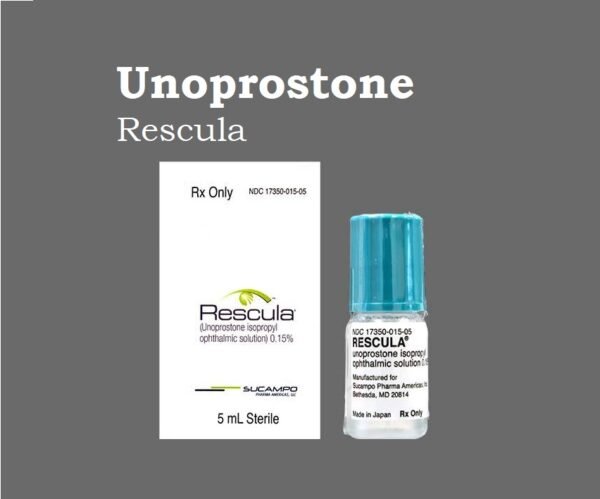
Unoprostone is a prostaglandin analog marketed by the brand name of Rescula. It is approved for the treatment of raised intraocular pressure.
Unoprostone Uses:
-
Open-angle glaucoma or ocular hypertension:
- To decrease intraocular pressure (IOP) in open-angle glaucoma patients or ocular hypertension
Unoprostone Dose in Adults
Unoprostone Dose in the treatment of Open-angle glaucoma or ocular hypertension:
- Ophthalmic: pour 1 drop into affected eye(s) 2 times per day
Unoprostone Dose in Childrens
Not indicated
Pregnancy Risk Factor C
- In animal reproduction studies, side effects were observed when administered subcutaneously at greater doses than the recommended human dose.
- Following ophthalmic administration, systemic absorption is minimal;
- systemic absorption is necessary in order for unoprostone to cross the placenta and reach the fetus.
- If ophthalmic drugs are required during conception, the minimum dose which is effective must be used along with punctual occlusion to decrease potential exposure to the fetus (Samples, 1988).
Unoprostone use during breastfeeding:
- whether unoprostone is excreted in breast milk is not known; however, systemic absorption is minimal following ophthalmic administration.
- The manufacturer recommends that caution be exercised when administering unoprostone to lactating women.
Rescula Dose in Kidney Disease:
- There are no dosage adjustments provided in the drug maker’s labeling.
- However, dosage adjustment unlikely due to low systemic absorption.
Rescula Dose in Liver disease:
- There are no dosage adjustments provided in the drug maker’s labeling.
- However, dosage adjustment unlikely due to low systemic absorption.
Common Side Effects of Unoprostone (Rescula):
-
Ophthalmic:
- Burning Sensation Of Eyes
- Stinging Of Eyes
- Eye Pruritus
- Eye Redness
- Xerophthalmia
- Increased Eyelash Length
Less Common Side Effects of Unoprostone (Rescula):
-
Cardiovascular:
- Hypertension
-
Central Nervous System:
- Foreign Body Sensation Of Eye
- Dizziness
- Headache
- Insomnia
- Pain
-
Endocrine & Metabolic:
- Diabetes Mellitus
-
Hypersensitivity:
- Hypersensitivity Reaction
-
Neuromuscular & Skeletal:
- Back Pain
-
Ophthalmic:
- Abnormal Lacrimation
- Eyelid Disease
- Visual Disturbance
- Decreased Eyelash Length
- Blepharitis
- Cataract
- Conjunctivitis
- Corneal Lesion
- Eye Discharge
- Eye Irritation
- Eye Pain
- Hemophthalmos
- Keratitis
- Photophobia
- Vitreous Disorder
-
Respiratory:
- Flu-Like Symptoms
- Bronchitis
- Cough
- Pharyngitis
- Rhinitis
- Sinusitis
-
Miscellaneous:
- Accidental Injury
Contraindications to Unoprostone (Rescula):
- In case of Hypersensitivity to unoprostone or any component of the formulation
Warnings and Precautions
-
Ocular pigmentation:
- May cause a permanent change in eye color as it increases the amount of brown pigment in the iris, which may not be noticeable for months to years);
- long-term side effects and potentially harmful injury to eye are not known.
- May also cause changes to periorbital tissues and eyelashes; which are reversible upon discontinuation in most patients.
-
Infection:
- Bacterial keratitis, caused by inadvertent contamination of multiple-dose ophthalmic solutions, has been reported.
- Minimize contamination by not touching the eyelids or surrounding areas with the dropper tip;
- keep the bottle tightly closed when not in use.
-
Ocular disease:
- Use with caution in patients with intraocular inflammation (eg, uveitis);
- may exacerbate intraocular inflammatory conditions.
- May cause macular edema, including cystoid macular edema;
- use cautiously in patients with no lens, pseudophakic patients with torn posterior lens capsules, or in patients who are at risk for macular edema.
Unoprostone: Drug Interaction
|
Nonsteroidal Anti-Inflammatory Agents |
May diminish the therapeutic effect of Prostaglandins (Ophthalmic). Nonsteroidal Anti-Inflammatory Agents may also enhance the therapeutic effects of Prostaglandins (Ophthalmic). |
|
Nonsteroidal Anti-Inflammatory Agents (Ophthalmic) |
May diminish the therapeutic effect of Prostaglandins (Ophthalmic). Nonsteroidal Anti-Inflammatory Agents (Ophthalmic) may enhance the therapeutic effect of Prostaglandins (Ophthalmic). |
Monitor:
- Intraocular pressure
- ocular infections (keratitis)
How to administer Unoprostone (Rescula)?
- May be used in combination with other eye drops to lower intraocular pressure;
- if using more than one product, wait for a minimum of 5 minutes between application of each medication.
- Remove contact lenses prior to administration and wait for at least 15 minutes before reinserting.
- Minimize contamination by not touching the eyelids or surrounding areas with the tip of dropper; keep bottle cap tightly closed when not in use.
Mechanism of action of Unoprostone (Rescula):
- The exact mechanism of action is unknown;
- however, unoprostone likely lowers IOP by increasing aqueous humor outflow.
- Cardiovascular and pulmonary function were not found to be affected in clinical studies.
- IOP was decreased by 3-4 mm Hg in patients with a mean baseline IOP of 23 mm Hg.
- IOP may also be lowered by increased trabecular meshwork outflow via stimulation of calcium-activated BK and CIC-2 type channels.
Absorption:
- Through cornea and conjunctival epithelium (minimal systemic exposure)
Metabolism:
- Hydrolyzed by esterases unoprostone-free acid
Half-life elimination:
- 14 minutes
Excretion: Urine (as metabolites)
International Brands of Unoprostone:
- Rescula
Unoprostone Brand Names in Pakistan:
No Brands Available in Pakistan.
.png)