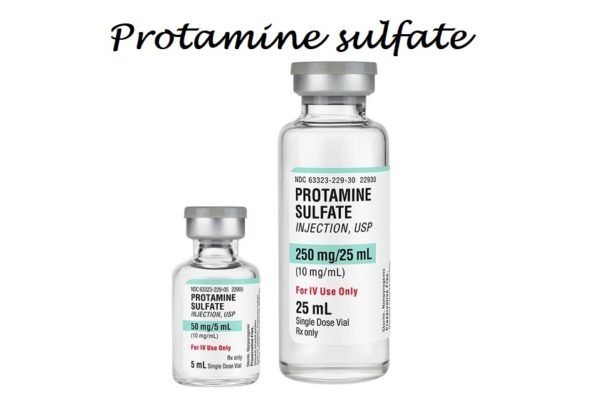
Protamine sulfate is used as an antidote in patients with heparin overdose. It may also be used to partially reverse the effects of LMWH (low molecular weight heparin) and fondaparinux. It is administered as an intravenous infusion, however, rapid administration of the drug should be avoided as it may cause life-threatening hypotension and anaphylactic reactions.
It may also be used as an off-label medicine in the following situations:
- Heparin neutralization
- Intracranial hemorrhage associated with the use of enoxaparin or other LMWH or unfractionated heparin.
- LMWH overdose.
Protamin sulfate dose in Adults
Protamin sulfate dose in patients with heparin overdosage (following intravenous administration):
- Heparin intravenous administration has a short half-life. Treatment with protamine sulfate depends on the time elapsed since the last dose as per the following table:
Protamine sulfate dose for intravenous Heparin Overdosage:
|
Time Elapsed |
The dose of Protamine to Neutralize 100 units of Heparin |
|
Immediate |
1 - 1.5 mg per 100 units of heparin administered |
| 30 - 60 minutes | 0.5 - 0.75 mg of protamine per 100 units of heparin |
| more than 2 hours | 0.25 - 0.375 mg per 100 units of heparin |
Protamine sulfate dose in Heparin overdosage following SubQ injection (off-label dosing):
- Administer 1 - 1.5 mg protamine per 100 units heparin.
- 25 - 50 mg is administered slowly intravenously followed by the rest of the dose over 8 - 16 hours.
Protamine sulfate dose to neutralize Heparin (off-label):
- 1 mg of protamine neutralizes about 100 units of heparin.
- The maximum single dose should not exceed 50 mg.
- The dose may be repeated at 0.5 mg per 100 units of heparin if the patient continues to bleed or if the aPTT remains elevated.
Heparin neutralization after Cardiac surgery:
- To reverse the large intraoperative doses of heparin administered during cardiopulmonary bypass surgery, repeat doses of 25 - 50 mg intravenously may be given if the activated clotting time (ACT) remains elevated or heparin rebound is a concern.
- A maximum dose of 3 mg/kg may be used.
- A continuous intravenous infusion of 25 mg/hour may be considered for 6 hours in patients with heparin rebound after the administration of the initial dose.
Protamine dose in patients with intracranial hemorrhage associated with heparin or LMWH (off-label):
- According to the Neurocritical Care Society/Society of Critical Care Medicine (NCS/SCCM [Frontera 2016]):
-
Heparin-mediated (full dose infusions):
-
- 1 mg of protamine neutralizes about 100 units of heparin administered in the previous 2 - 3 hours. It should be administered as a slow intravenous infusion over 10 minutes.
- The maximum single dose should not exceed 50 mg.
- The dose may be repeated at 0.5 mg per 100 units of heparin if the patient continues to bleed or if the aPTT remains elevated.
- The reversal for prophylactic subcutaneous doses is not usually recommended, however, if the aPTT is significantly prolonged, protamine sulfate may be indicated.
-
-
LMWH-mediated (full therapeutic dose):
- Note: Patients receiving prophylactic doses of LMWH, the NCS/SCCM guidelines suggest against reversal.
-
Enoxaparin:
-
- Enoxaparin administered within the last 8 hours:
- 1 mg of protamine should be administered per 1 mg of enoxaparin intravenously.
- Enoxaparin is administered more than 8 hours ago or a second dose of protamine is required (eg, the patient continues to bleed or the aPTT remains prolonged 2 - 4 hours after the first dose of protamine sulfate)
- Administer 0.5 mg of protamine sulfate per 1 mg of enoxaparin as a slow intravenous injection over 10 minutes to a maximum dose of 50 mg er dose.
- If the patient has renal impairment or life-threatening bleeding persists, repeat doses of 0.5 mg protamine for every 1 mg of enoxaparin may be used.
- Note: if 3 - 5 half-lives have elapsed, protamine may not be advisable.
- Enoxaparin administered within the last 8 hours:
-
Dalteparin, nadroparin, and tinzaparin:
- 1 mg of protamine for every 100 units of dalteparin should be administered by slow intravenous infusion.
- An additional dose of 0.5 mg per 100 units dalteparin may be administered if the patient has renal impairment or life-threatening.
- The maximum dose is 50 mg per dose.
-
-
-
Protamine sulfate dose in patients with LMWH overdose as off-label use:
- Note: LMWH is partially neutralized (about 60% - 75%) and excessive protamine administration may result in bleeding.
-
Enoxaparin:
-
- Enoxaparin administered within the last 8 hours:
- 1 mg of protamine should be administered per 1 mg of enoxaparin intravenously.
- Enoxaparin is administered more than 8 hours ago or a second dose of protamine is required (eg, the patient continues to bleed or the aPTT remains prolonged 2 - 4 hours after the first dose of protamine sulfate)
- Administer 0.5 mg of protamine sulfate per 1 mg of enoxaparin.
- Enoxaparin administered within the last 8 hours:
-
-
Dalteparin:
- 1 mg of protamine for every 100 units of dalteparin or tinzaparin.
- An additional dose of 0.5 mg per 100 units dalteparin or tinzaparin may be administered if the patient continues to bleed or the aPTT is prolonged 2 to 4 hours after the first dose of protamine sulfate.
-
Protamin sulfate dose in Childrens
Protamine sulfate in children for the neutralization of Heparin or enoxaparin:
- The dose of protamine sulfate is determined by the most recently (within 2 hours) infused dose of heparin or low molecular weight heparin.
- 1 mg of protamine sulfate neutralizes 100 units of heparin or 1 mg of LMWH.
- The maximum dose is 50 mg per dose.
Protamine sulfate dosage in patients with intravenous administration of heparin:
- Since intravenous heparin has a short half-life, the dose should be determined according to the following table:
|
Time Since Last Heparin Dose (min) |
The dose of Protamine (mg) to Neutralize 100 units of Heparin |
| Less than 30 minutes | 1 mg per 100 units of heparin |
| 30 - 60 minutes | 0.5 - 0.75 mg |
| 60 - 120 minutes | 0.375 - 0.5 mg |
| more than 120 minutes | 0.25 - 0.375 mg |
Patients with heparin overdosage following subcutaneous administration:
- 1 - 1.5 mg of protamine sulfate per 100 units of heparin.
- The total dose may be administered in two divided doses as:
- 25 - 50 mg is administered as a slow intravenous infusion.
- Followed by the rest of the dose in over 8 - 16 hours as a continuous infusion.
Protamine dose in patients with LMWH overdosage (enoxaparin, dalteparin):
- Note: It partially neutralizes the effects of LMWH and Anti-Xa activity (60% - 75%). Excessive doses may result in coagulopathy and worsen the underlying condition.
-
Enoxaparin:
- Enoxaparin administered within the last 8 hours:
- 1 mg of protamine should be administered per 1 mg of enoxaparin intravenously.
- Enoxaparin is administered more than 8 hours ago or a second dose of protamine is required (eg, the patient continues to bleed or the aPTT remains prolonged 2 - 4 hours after the first dose of protamine sulfate)
- Administer 0.5 mg of protamine sulfate per 1 mg of enoxaparin.
- Enoxaparin administered within the last 8 hours:
-
Dalteparin:
- 1 mg of protamine for every 100 units of dalteparin.
- An additional dose of 0.5 mg per 100 units dalteparin may be administered if the patient continues to bleed or the aPTT is prolonged 2 to 4 hours after the first dose of protamine sulfate.
-
Pregnancy Risk Factor C
- There is little data regrding its use in pregnant patients.
- However, in patients with a clear indication for its use, the administration of the drug should not be delayed because of fears of teratogenicity.
- It may also be used during the peripartum period in patients with heparin or enoxaparin (LMWH) induced coagulopathy.
Protamine sulfate use during breastfeeding:
- The excretion of the drug into breastmilk is not known.
- The manufacturer recommends using it with caution in nursing women.
Protamine sulfate dose in kidney disease:
The manufacturer has not recommended any adjustment in the dose in patients with kidney disease.
Protamine sulfate dose in liver disease:
The manufacturer has not recommended any adjustment in the dose in patients with liver disease.
Protamine sulfate side effects:
-
Cardiovascular:
- Bradycardia
- Flushing
- Hypotension
- Sudden Decrease Of Blood Pressure
-
Central Nervous System:
- Lassitude
-
Gastrointestinal:
- Nausea
- Vomiting
-
Hematologic & Oncologic:
- Hemorrhage
-
Hypersensitivity:
- Hypersensitivity Reaction
-
Respiratory:
- Dyspnea
- Pulmonary Hypertension
Protamine sulfate contraindications:
Allergic reactions to protamine or any component of the formulation
Warnings and Precautions
-
Heparin rebound:
- Heparin rebound is considered to be the most common cause of bleeding after cardiac by-pass surgery (CABG).
- Patients develop a bleeding diathesis 8 - 9 hours after protamine sulfate infusion is stopped.
- Heparin rebound may occur as long as 18 hours after the administration of protamine sulfate.
-
Hypersensitivity reactions:
- Severe hypersensitivity reactions may occur especially in patients with rapid intravenous administration. Epinephrine 1 mg/mL and other resuscitation equipment must be available for emergency management.
- [US Boxed Warning]: It may also cause severe hypotension and shock, noncardiogenic pulmonary edema, pulmonary vasoconstriction, and pulmonary hypertension.
- Patients at risk of severe life-threatening reactions include those receiving high doses of the drug, repeated administration, previous history of receiving protamine sulfate infusion, patients with allergy to fish, severe left ventricular dysfunction, vasectomy, and abnormal pulmonary hemodynamics before the surgery.
- Furthermore, severe and refractory hypotension and anaphylactic reactions may occur following the rapid administration of the drug.
Monitor:
- Coagulation test including aPTT or ACT
- Cardiac monitoring and monitoring of blood pressure is recommended during its administration.
How to administer Protamine sulfate?
- It should only be administered intravenously.
- Administer slowly as an intravenous IV push.
- 50 mg of protamine may be administered over ten minutes.
- Rapid intravenous administration may result in hypotension.
- The maximum infusion rate of 5 mg/minute should not be exceeded.
Protamine sulfate mechanism of action:
- Protamine sulfate is a highly alkaline basic protein.
- It is derived from fish sperm that binds to the negatively charged heparin molecule forming a stable complex.
- It displaces anti-thrombin III from the heparin:anti-thrombin III complex.
- It has little effect on reversing the anticoagulant activity of enoxaparin and fondaparinux.
- In higher doses, it may cause platelets clumping resulting in thrombocytopenia and interfere with the formation of fibrin.
- Thus, it may cause bleeding in high doses.
The onset of action after intravenous administration is about 5 minutes. It has a half-life elimination of about 7 minutes.
Protamine sulfate brand name (international):
- Denpru
- Prosulf
- Protamina
- Protamina solfato
- Protamine Choay
- Protamine Sulfate Injection
- Protamine Sulphate
- Protamine Sulphate Injection BP
- Protamini Sulfas
- Protaminsulfat
- Protaminsulfat Novo
- Protaminsulfat ”Leo”
Protamin sulfate Brands in Pakistan
Protamine (Sulphate) [Inj 10 mg/ml] |
|
| Protamine Sulphate | Lahore Chemical & Pharmaceutical Works (Pvt) Ltd |
| Protamine Sulphate | Zam Zam Corporation |
.png)


