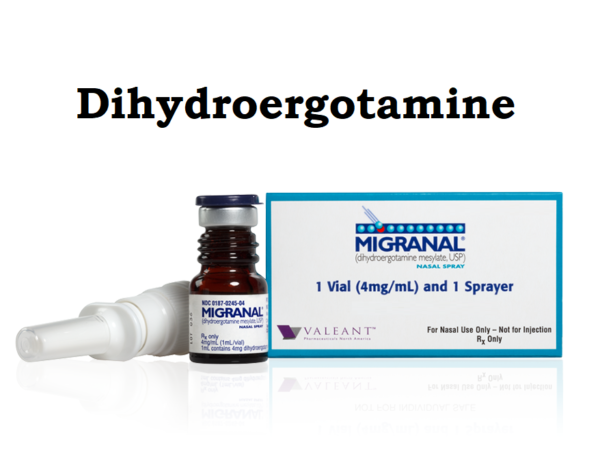
Dihydroergotamine is an ergot derivative available as a nasal spray and as an intravenous formulation for the treatment of migraine. It is a vasoconstrictor and has efficacy similar to sumatriptan.
Dihydroergotamine Uses:
-
Cluster headaches (injection):
- Acute treatment of cluster headaches.
-
Migraines (intranasal and injection):
- Acute treatment of migraine headaches with or without aura; not meant for the prophylactic therapy of migraine or for the management of hemiplegic or basilar migraine.
-
Off Label Use of Dihydroergotamine in Adults:
- Medication-overuse headache or intractable migraine headache (status migrainosus)
- Orthostatic hypotension
- Pelvic congestion with pain
Dihydroergotamine Dose in Adults:
Dihydroergotamine Dose in the treatment of Migraine and cluster headache:
-
Intramuscular Subcutaneous:
- 1 mg should be given at first sign of headache;
- The dose should be repeated hourly to a maximum dose of 3 mg/24hr;
- Do not to exceed: 6 mg/week
-
Intravenous:
- 1 mg should be given at first sign of headache;
- Repeat the dose every hour up to a maximum dose of 2 mg/24hr;
- Do not to exceed: 6 mg/week
-
Intranasal:
- 1 spray (0.5 milligrams) of nasal spray in both nostrils;
- repeat after every 15 minutes for a total of Four sprays (2 milligrams).
-
Note:
- Studies have failed to show any additional benefit from acute doses greater than 2 mg for a single migraine administration.
- The safety of doses greater than Six sprays (3 milligrams) in a 24-hr period or eight sprays (4 milligrams) in one week has not been established.
- It should not be used for chronic daily administration.
Dihydroergotamine dose for medication-overuse headache or intractable migraine headache (status migrainosus) as an alternative agent:
Note:
- Use in admitted patients for a medication-overuse headache when patients are unlikely to be successful by stopping the overused medication along with rescue therapy and preventive therapy.
- Premedicate with metoclopramide for nausea;
- During therapy, administer metoclopramide for nausea, diphenoxylate with atropine as required for diarrhea, and benztropine as required for akathisia or dystonic reactions.
- Some clinicians also use modified versions of the above-mentioned protocols with additional adjunctive medications &/or alternate antiemetic agents.
-
Repetitive dosing regimen (Raskin protocol):
-
Intravenous:
- Initial: 0.5 milligram
- The subsequent dose should be titrated based on response and tolerability (range: 0.2 to 1 milligram) q8 hours for up to seven days (most of the patients will be headache-free within 72 hours).
- If the headache persists but there is no nausea following the initial dose, the second dose of 0.5 milligrams may be given in 1 hour.
-
-
Continuous dosing regimen (Ford protocol):
-
Intravenous:
- 3 milligram in 1L of NS at 42 mL/hour for up to seven days (most of the patients will be headache-free within 72 hours).
- If significant nausea persists, the rate should be reduced to 21 to 30 mL per hour.
-
Dihydroergotamine Dose in Childrens:
Dihydroergotamine Dose in the treatment of Intractable Migraine lasting more than 72 hours (status migrainosus):
- Intravenous: Premedicate with antiemetic like metoclopramide or prochlorperazine which have been used previously
-
Low-dose regimen:
Note:
Improvement usually appears after five doses; some experts have recommended giving 1 additional dose after headache subsides. If no improvement observed after 5 doses, therapy should be discontinued.
-
Children 6 to <10 years:
- 1 milligram/dose q6 hours;
- Up to eight doses of therapy should be administered every episode, or until the patient is headache-free.
-
Children 10 to 12 years
- 15 milligram/dose q6 hours
- Therapy should be continued until headache-free up to a maximum of 8 doses per episode.
-
Adolescents ≤16 years:
- 2 milligram/dose q6 hours
- Up to eight doses of therapy should be administered every episode, or until the patient is headache-free.
-
High-dose regimen:
Note:
Improvement is usually noted after 5 doses; some experts recommend giving 1 additional dose after the headache has subsided. If there is no improvement after 5 doses, therapy should be discontinued. Some experts have recommended using an initial test dose (half of the appropriate dose for age and weight); If the test dose is tolerated, remainder of the dose should be administered 30 minutes later.
-
Children 6 to 9 years or Children ≥10 years who weigh <25 kg:
- 5 milligram/dose q8 hours; if the improvement is seen
- Therapy should be continued until headache-free up to a maximum of 15 doses per episode.
-
Children ≥10 years weighing >25 kg and Adolescents:
- 1 milligram/dose q8 hours
- If improvement is seen, therapy should be continued until headache-free up to a maximum of 15 doses per episode.
Intranasal dihydroergotamine:
-
Adolescents:
- 1 spray (0.5 milligrams) into both nostrils (total dose: 1 milligram)
- Adult data suggests that dose has to be repeated after 15 minutes for a total of Four sprays (2 milligrams)
- Maximum daily dose: 6 sprays (3 mg) per24-hour period
- Note: Not to exceed 8 sprays (4 milligrams)/week.
Pregnancy Risk Factor X
- Dihydroergotamine can be used as an oxytocic.
- It is not recommended to be used during pregnancy.
Use of dihydroergotamine during breastfeeding
- Prolactin can be inhibited with ergot derivatives. Ergotamine has been known to be excreted from breast milk (vomiting and diarrhea have been reported in nursing infants).
- These effects could also be caused by dihydroergotamine. However, this drug is unlikely to be found in breast milk. It is not recommended for use in nursing mothers.
[/bg_collapse] [bg_collapse view="button-blue" color="#f7f2f2" icon="arrow" expand_text="Renal Dose" collapse_text="Renal Dose" ]
Dose in Kidney Disease:
-
Mild to moderate impairment:
- No dosage adjustments on labeling.
-
Severe impairment:
- Contraindicated.
[/bg_collapse] [bg_collapse view="button-blue" color="#f7f2f2" icon="arrow" expand_text="Dose in Liver disease" collapse_text="Dose in Liver disease" ]
Dose in Liver disease:
-
Mild to moderate impairment:
- No dosage adjustments on labeling.
-
Severe impairment:
- Contraindicated.
[/bg_collapse] [bg_collapse view="button-blue" color="#f7f2f2" icon="arrow" expand_text="Side effects" collapse_text="Side effects" ] Nasal spray:
Common Side Effects of Dihydroergotamine:
-
Respiratory:
- Rhinitis
Less Common Side effects of Dihydroergotamine:
-
Central nervous system:
- Taste disorder
- Dizziness
- Drowsiness
-
Endocrine & metabolic:
- Hot flash
-
Gastrointestinal:
- Nausea
- Vomiting
- Diarrhea
-
Local:
- Application site reaction
-
Neuromuscular & skeletal:
- Stiffness
- Weakness
-
Respiratory:
- Pharyngitis
[/bg_collapse] [bg_collapse view="button-blue" color="#f7f2f2" icon="arrow" expand_text="Contraindications & warnings" collapse_text="Contraindications & warnings" ]
Contraindications to Dihydroergotamine:
- Hypersensitivity to dihydroergotamine and any component of the formulation
- Uncontrolled hypertension, IHD or angina pectoris, history MI, silent ischemia or coronary artery vasospasm, including Prinzmetal angina, are all possible.
- Basilar or hemiplegic migraine
- Peripheral vascular disease
- Sepsis
- Grave hepatic and renal dysfunction
- Following vascular surgery
- Avoid using 5-hydroxytryptamine-1 (5HT1a) receptor agonists ( triptans), serotonin-agonists or ergots within 24 hours.
- Concurrent use central and peripheral vasoconstrictors
- Concurrent use potent inhibitors for CYP3A4 (includes protease inhibitors, azole Antifungals and some macrolide Antibiotics);
- Pregnancy
- Breastfeeding
Warnings and precautions
-
Cardiac Valvular Fibrosis:
- The fibrotic valve thickening caused by ergot alkaloids has been linked to a variety of conditions, including aortic, mitral and tricuspid. This condition is usually caused by long-term, persistent use.
-
Cardiovascular effects
- It may cause vasospastic reaction, which can be associated with muscle pains, numbness and coldness, and cyanosis. Myocardial and peripheral arterial ischemia have been reported.
- Patients with impaired circulation may experience persistent vasospasm, which can lead to gangrene and even death.
- Patients who have signs or symptoms that suggest angina after receiving CAD medication or a predisposition for variant angina should be evaluated.
- Patients who have other symptoms, such as Raynaud syndrome or ischemic bowel syndrome, that suggest decreased arterial flow should also be evaluated.
- A rare case of significant hypertension was reported in a patient with and without hypertension.
- Rarely have adverse cardiac events been reported, including death, acute MI, or life-threatening arrhythmias.
-
Cerebrovascular events
- After the injection, stroke, subarachnoid hemorhage, and cerebral hemorhage have all been reported (some cases even fatal).
-
Retroperitoneal and pleural fibrosis
- Rare cases of retroperitoneal and pleural fibrosis have been reported.
-
Cardiovascular disease
- Patients with risk factors for CAD should not be treated until a cardiology evaluation has been completed.
- If the evaluation is positive, the healthcare provider should administer 1st dose. Cardiovascular status should also be checked periodically.
[/bg_collapse] [bg_collapse view="button-blue" color="#f7f2f2" icon="arrow" expand_text="Drug Interactions" collapse_text="Drug Interactions" ]
Dihydroergotamine: Drug Interaction
Note: Drug Interaction Categories:
- Risk Factor C: Monitor When Using Combination
- Risk Factor D: Consider Treatment Modification
- Risk Factor X: Avoid Concomitant Use
Risk Factor C (Monitor therapy).
Antiemetics (5HT3 Antagonists). Serotonin Activators' serotonergic actions could be enhanced by this. The serotonin syndrome might result from this. Antipsychotic Agents If antipsychotic drugs are controlled with serotonin modulators, the negative/toxic effects may be more pronounced.Neuroleptic malignant syndrome may be more likely to develop if serotonin modulators increase dopamine blockade.Antipsychotic drugs may augment the serotonergic effects of serotonin modulators.
The serotonin syndrome might result from this.Aprepitant High likelihood that inhibitors will raise serum concentrations of CYP3A4 substrates Chloroprocaine May intensify ergot derivatives' hypertensive effects. Clofazimine High likelihood that inhibitors will raise serum concentrations of CYP3A4 substrates Moderate CYP3A4 inhibitors Might decrease metabolism of CYP3A4 substrates (High Risk with Inhibitors). Duvelisib High risk of Inhibitors causing an increase in serum CYP3A4 Substrates concentrations Erdafitinib High risk of Inhibitors causing an increase in serum CYP3A4 Substrates concentrations Fosaprepitant High risk of Inhibitors causing an increase in serum CYP3A4 Substrates concentrations Fosnetupitant High risk of Inhibitors causing an increase in serum CYP3A4 Substrates concentrations Larotrectinib High risk of Inhibitors causing an increase in serum CYP3A4 Substrates concentrations Metaxalone This may increase the serotonergic effects of Serotonin Activators. This could lead to serotonin syndrome. Methylphenidate Can increase the toxic/adverse effects of Serotonin Modulators. In particular, there may be an increase in the risk of serotonin syndrome and serotonin toxicities. Metoclopramide The adverse/toxic effects of Metoclopramide may be exacerbated by Serotonin Modulators. This could manifest as serotonin syndrome, neuroleptic malignant syndrome, or other symptoms. Netupitant High risk of Inhibitors causing an increase in serum CYP3A4 Substrates concentrations Opioid Agonists This may increase the serotonergic effects of Serotonin Activators. This could lead to serotonin syndrome. Palbociclib High likelihood that inhibitors will raise serum concentrations of CYP3A4 substrates Reboxetine May intensify ergot derivatives' hypertensive effects. Serotonin Modulators This might make other serotonin activators more toxic or harmful. Simeprevir High likelihood that inhibitors will raise serum concentrations of CYP3A4 substrates Tedizolid This might make other serotonin activators more toxic or harmful.The serotonin syndrome may manifest.
The exceptions are Tedizolid and Nicergoline.Serotonin Activators' serotonergic actions could be enhanced by this.The serotonin syndrome might result from this.Serotonin Modulators may enhance TraMADol's harmful/toxic effects.Seizures can get worse.TraMADol Serotonin Activators' serotonergic actions could be enhanced by TraMADol.
The serotonin syndrome might result from this.Risk Factor D (Consider therapy modifications)
Anti-Parkinson Agents (Monoamine oxidase inhibitor) Serotonin Activators' serotonergic actions could be enhanced by this. The serotonin syndrome might result from this. A serotonin modator can be used in conjunction with selegiline, rasagiline, or safinamide to monitor for serotonin syndrome/serotonin toxicemia symptoms and signs. Combining transdermal selegiline with serotonin moderators is not advised. Beta-Blockers May increase the vasoconstricting effects of Ergot Derivatives. Strong CYP3A4 inhibitors Could possibly reduce the metabolism of CYP3A4 substrates (High Risk with Inhibitors). Linezolid This may increase the serotonergic effects of Serotonin Activators. This could lead to serotonin syndrome. Management: Serotonin syndrome/serotonin toxicemia can occur if serotonin modulators are stopped 2 weeks before linezolid is administered. Stop using serotonin modators immediately if you need to initiate linezolid immediately. Antibiotics with Macrolide Could increase serum concentrations of Ergot Derivatives. Cabergoline, Clarithromycin and Fidaxomicin may interact. Refer to the specific monograph for more details. Azithromycin (Systemic); Fidaxomicin, Spiramycin are exceptions. Stiripentol .High chance that inhibitors will raise serum levels of CYP3A4 substrates. Treatment: Steer clear of using stiripentol with CYP3A4 substrates that have a limited therapeutic index. This is done to prevent negative consequences and toxicity. Any CYP3A4 substrate that is administered in conjunction with stiripentol should be strictly monitored. Risk Factor X (Avoid the combination)
Alpha-/Beta Agonists Alpha-/BetaAgonists' hypertensive effects may be enhanced by Ergot Derivatives. Alpha-/Beta Agonists' vasoconstricting effects may be enhanced by Ergot Derivatives Alpha1-Agonists Alpha1-Agonists' hypertensive effects may be enhanced by Ergot Derivatives. Alpha1-Agonists' vasoconstricting effects may be enhanced by using Ergot Derivatives. Antihepaciviral combination products May increase serum concentrations of Ergot Derivatives. Clarithromycin May increase serum Dihydroergotamine concentrations Cobicistat May increase serum Dihydroergotamine concentrations Conivaptan High risk of Inhibitors causing an increase in serum CYP3A4 Substrates concentrations Crizotinib May increase serum Dihydroergotamine concentrations Dapoxetine Can increase the toxic/adverse effects of Serotonin Activators. Enzalutamide Could lower the serum concentrations of Dihydroergotamine. Fusidic Acid (Systemic). High risk of Inhibitors causing an increase in serum CYP3A4 Substrates concentrations Idelalisib High risk of Inhibitors causing an increase in serum CYP3A4 Substrates concentrations Itraconazole May increase serum Dihydroergotamine concentrations Ketoconazole Systemic May increase serum Dihydroergotamine concentrations Letermovir May increase serum concentrations of Ergot Derivatives. Lorcaserin Could increase the toxic/adverse effects of Ergot Derivatives. Particularly, the combination of these drugs may increase your risk of developing valvular disease. Lorcaserin could increase the serotonergic effects of Ergot Derivatives. This could lead to serotonin syndrome. Methylene Blue This may increase the serotonergic effects of Serotonin Activators. This could lead to serotonin syndrome. MiFEPRIStone This may increase serum levels of Dihydroergotamine. Treatment: Do not take dihydroergotamine for Cushing's syndrome hyperglycemia. Although the interaction magnitude may be smaller with single doses of mifepristone used to terminate a pregnancy, clinically neither effect has been examined. Nitroglycerin Ergot derivatives can decrease the vasodilatory effects of Nitroglycerin. This is especially important for patients with angina. The serum concentrations of Ergot Derivatives may be increased by Nitroglycerin. Posaconazole May increase serum Dihydroergotamine concentrations Protease inhibitors May increase serum concentrations of Ergot Derivatives. Roxithromycin May increase serum concentrations of Ergot Derivatives. Serotonin 5-HT1D Receptor Agonists The vasoconstricting effects of Serotonin 5-HT1D Receptor Aggonists may be enhanced by Ergot Derivatives. The vasoconstricting effects of Ergot Derivatives could be enhanced by Serotonin 5-HT1D Receptor Aggonists. Voriconazole May increase serum Dihydroergotamine concentrations
[/bg_collapse] [bg_collapse view="button-blue" color="#f7f2f2" icon="arrow" expand_text="Monitoring parameters" collapse_text="Monitoring parameters" ]
Monitoring parameters:
- Monitor ECG in patients with risk factors for heart diseases.
- Obtain Pulmonary function tests and Echocardiography prior to the treatment.
[/bg_collapse] [bg_collapse view="button-blue" color="#f7f2f2" icon="arrow" expand_text="How to administer?" collapse_text="How to administer?" ]
How to administer Dihydroergotamine?
Intranasal
- The nasal spray applicator should be primed (4 pumps) before administering nasal spray.
- Patients should not inhale deeply into the nose while spraying the drug or shortly thereafter to allow it to absorb through the skin.
- For best results, it is important to begin treatment as soon as possible after a symptom or sign has appeared.
- However, nasal sprays can be used at any stage of a migraine attack.
IV:
-
The Ford protocol:
- Continuous infusions should be given; for more information on dosing, refer to the indication-specific infusion rates.
-
Repetitive dosing (Raskin protocol).
- Slowly administer the medication for 2 to 3 minutes.
[/bg_collapse] [bg_collapse view="button-blue" color="#f7f2f2" icon="arrow" expand_text="Pharmacology & MOA" collapse_text="Pharmacology & MOA" ]
Mechanism of action of dihydroergotamine:
- The activation and activation of 5-HT-1D 5-HT-1D receptors at intracranial blood vessels causes migraine efficacy. This results in vasoconstriction and activation of 5-HT-1D 5-HT-1D sensory nerve endings of trigeminal system, ultimately leading to inhibition of pro-inflammatory neuropeptide release.
- Dihydroergotamine is highly able to bind with serotonin 5-HT-1Da, 5-HT-1Dss, 5-HT-1A and 5-HT-2A receptors, noradrenaline receptors a2A and a2B, as well as dopamine D-2L, and D-3 receptors.
- Dihydroergotamine has also oxytocic properties.
Protein binding: 93 Percent Metabolism: A lot of hepatic metabolism (one active compound, 8'-bhydroxydihydroergotamine). Bioavailability:
- Intramuscular, intravenous: 100 percent
- Intranasal: 40% (Saper 2006).
Eliminating half-life: 9-10 hrs Time to peak, serum:
- Intramuscular: 24 minutes
- Intravenous: 1 - 2 minutes
- Intranasal: 30-60 minutes (Saper 2006).
- Subcutaneous:15 to 45 minutes (Schran 1985).
Excretion:
- Primarily, feces
- Urine (6% - 7% as an unchanged drug)
[/bg_collapse] [bg_collapse view="button-blue" color="#f7f2f2" icon="arrow" expand_text="International Brands" collapse_text="International Brands" ]
International Brands of Dihydroergotamine:
- H.E. 45
- Migranal
- H.E
- Cervasal
- Dergott
- Detemes Retard
- Detms
- DH-Ergotamin
- DHT
- Diergo
- Diergospray
- Digalo
- Dihydergot
- Dihydergot Sandoz
- Dihydroergotamin ”Dak”
- Dihydroergotaminum Methansulfonicum
- Dihydroergotaminum Tartaricum
- Ditamin
- Ergotamina
- Ergovasan
- Ginik
- Hadermik/Migomik
- Ikaran
- Ikaran LP
- Migranal
- Migranil
- Neomigran
- Orstanorm
- Parsel
- Rayor
- Seglor
- Seglor Retard
- Tamik
- Tonopan
- Verladyn
[/bg_collapse] [bg_collapse view="button-blue" color="#f7f2f2" icon="arrow" expand_text="Brands in Pakistan" collapse_text="Brands in Pakistan" ]
Dihydroergotamine Brands Names in Pakistan:
No Brands Available in Pakistan. [/bg_collapse]
.png)


