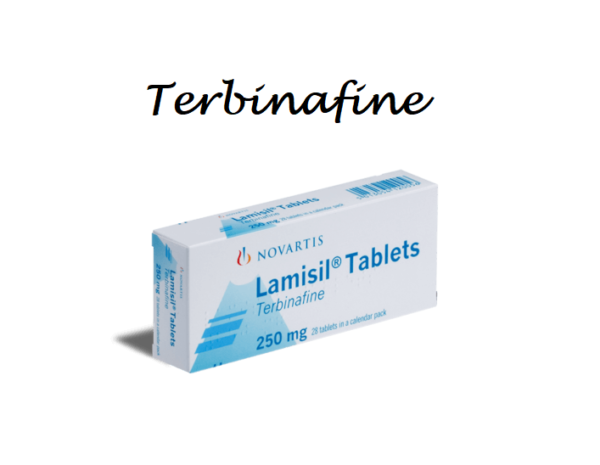
Terbinafine (Lamisil) is an antifungal medicine that is available both as oral tablets and topical formulations for the treatment of fungal infections.
-
Onychomycosis (tablets only):
-
It is used in the treatment of onychomycosis of the toenail or fingernail caused by dermatophytes (tinea unguium).
-
-
Tinea capitis (granules only):
-
It is used in the treatment of tinea capitis in patients 4 years and older.
-
-
Off Label Usage of Terbinafine in Adults:
-
It is also used in following conditions:
-
Dermatophyte folliculitis (tinea barbae, Majocchi granuloma);
-
Sporotrichosis (lymphocutaneous and cutaneous);
-
Tinea capitis;
-
Tinea corporis/tinea cruris/tinea faciei;
-
Tinea pedis/tinea manuum
-
Terbinafine Dose in Adults
Terbinafine dosage in the treatment of Onychomycosis:
-
Continuous dosing:
- 250 mg tablets orally once daily given for 6 weeks (fingernail) or 12 weeks (toenail).
-
Pulsed dosing (alternative dosing method) (off-label):
- 250 mg tablets orally once daily given for 4 weeks, then off for 4 weeks, then resume with 250 mg once daily for 4 weeks or 250 mg twice daily for 7 days repeated every 4 weeks for 3 months
- Pulsed dosing is less useful but may reduce the risk of adverse effects, reduce cost, and improve patient compliance
Dosage in the treatment of Sporotrichosis, lymphocutaneous and cutaneous (alternative agent for patients who do not respond to itraconazole) (off-label):
- 500 mg tablets orally twice daily given
- Treat for 2 to 4 additional weeks after all lesions have been resolved
- The usual duration is 3 to 6 months
Dosage in the treatment of Tinea infections:
-
Dermatophyte folliculitis (tinea barbae, Majocchi granuloma) (off-label):
- 250 mg tablets orally once daily given
- duration is typically 2 to 6 weeks but might need to be extended (eg, in immunocompromised patients with slow response)
-
Tinea capitis (off-label):
- 250 mg tablets orally once daily given for 4 to 6 weeks.
-
Tinea corporis/tinea cruris/tinea faciei (alternative agent) (off-label):
- Lamisil may be used as an alternative treatment for patients in whom topical therapy has failed and those with extensive skin involvement.
- 250 mg tablets orally once daily given for 1 to 2 weeks
Tinea pedis/tinea manuum (alternative agent) (off-label):
- Lamisil may be used as an alternative treatment for patients in whom topical therapy has failed and those with extensive skin involvement.
- 250 mg tablets orally once daily given for 2 weeks
Terbinafine dose in Childrens
Dosage in the treatment of Tinea capitis:
- Children ≥4 years and Adolescents: Oral: Granules:
- <25 kg:
- 125 mg once daily given for 6 weeks
- 25 to 35 kg:
- 5 mg once daily given for 6 weeks
- >35 kg:
- 250 mg once daily given for 6 weeks
- <25 kg:
Terbinafine dosage in the treatment of Onychomycosis:
- Children and Adolescents:
- 10 to 20 kg:
- 5 mg orally once daily given for 6 weeks (fingernails) or 12 weeks (toenails)
- 20 to 40 kg:
- 125 mg orally once daily given for 6 weeks (fingernails) or 12 weeks (toenails)
- >40 kg:
- 250 mg orally once daily given for 6 weeks (fingernails) or 12 weeks (toenails)
- 10 to 20 kg:
Terbinafine pregnancy Risk category: B
- There is insufficient published information on the use of systemic Terbinafine during pregnancy.
- Pregnancy is not a good time to try systemic therapy for tinea capitis or onychomycosis.
Terbinafine use during breastfeeding:
- Breast milk usually contains Terbinafine.
- It is not recommended to breastfeed during systemic treatment
- According to the manufacturer breastfeeding during therapy should be considered in light of the risks to infants and the benefits to mothers.
Terbinafine (Lamisil) dose in renal disease:
- There are no dosage adjustments given in the manufacturer's labeling (has not been studied)
- But, clearance is decreased by 50% in patients with CrCl ≤50 mL/minute.
Terbinafine Dose in Liver Disease:
- It is Contraindicated in chronic or active hepatic disease.
Common Side Effects of Terbinafine Include:
-
Central nervous system:
- Headache
Less Common Side Effects of Terbinafine Include:
-
Dermatologic:
- Skin Rash
- Pruritus
- Urticaria
-
Gastrointestinal:
- Diarrhea
- Vomiting
- Dyspepsia
- Upper Abdominal Pain
- Dysgeusia
- Nausea
- Abdominal Pain
- Pharyngolaryngeal Pain
- Toothache
-
Hepatic:
- Liver Enzyme Disorder
-
Infection:
- Influenza
-
Ophthalmic:
- Vision Color Changes
- Decreased Visual Acuity
-
Respiratory:
- Nasopharyngitis
- Cough
- Upper Respiratory Tract Infection
- Nasal Congestion
- Rhinorrhea
-
Miscellaneous:
- Fever
Contraindication to Terbinafine Include:
- Hypersensitivity to terbinafine and any component of the formulation
- Chronic or active hepatic diseases
Warnings and precautions
-
Antifungal hypersensitivity to Allylamine
- Patients sensitive to allylamine antifungals (eg naftifine or butenafine), should be cautious.
- Cross-sensitivity to Terbinafine could exist.
-
Depression
- It was seen with the use
- Patients should report any depressive symptoms or mood changes.
-
Gastrointestinal effects:
- There have been cases of severe cases where taste disturbances (including loss or impairment) can lead to decreased food intake, weight loss, anxiety, and depression.
- Sometimes, the resolution may take several weeks or more to occur after therapy has ended. In some cases, the disturbance could be permanent.
- Stop treating patients suffering from taste disturbances.
-
Hematologic effects
- Clinical trials showed that absolute lymphocyte count decreased in a temporary manner.
- Also, severe neutropenia has been reported (reversible after discontinuation).
- If treatment is to be administered for more than 6 weeks, monitor the CBC.
- If ANC is less than 1,000/mm, stop therapy
-
Hepatic failure
- There have been cases of hepatic dysfunction that can lead to liver transplantation or even death.
- This could occur in both patients with and without a preexisting liver disease.
- Patients with chronic or active hepatic disease may experience more severe hepatic events.
- At baseline, liver function tests should always be done.
- If there is any evidence of liver injury (eg, nausea or vomiting, right upper abdominal pain, jaundice and dark urine, pale stool) or elevated liver function test results, discontinue use.
-
Hypersensitivity
- Severe skin and hypersensitivity reactions have been reported (eg, Stevens Johnson syndrome, toxic epidermal Necrolysis, bullous Dermatitis, Stevens-Johnson Syndrome, bullous Dermatitis, toxic epidermal Neolysis, bullous Dermatitis, exfoliative Dermatis Drug Reaction with Eosinophilia, and Systemic Symptoms [DRESS] syndrome).
- Stop treating if you experience progressive skin rash, or hypersensitivity reactions.
-
Ocular effects
- Even though it is rare, there have been changes in the retina and ocular lenses.
- It is possible to discontinue therapy.
-
Respiratory effects
- There have been reports of smell disturbances (including loss or smell).
- Sometimes, the resolution may take longer than expected, such as >1 year after discontinuation of therapy. In some cases, it may become permanent.
- Stop treating patients suffering from smell disturbance.
-
Thrombotic microangiopathy
- There have been cases of thrombotic miopathy (TMA), which includes hemolytic uremic syndrome and thrombotic tubular purpura.
- Stop if TMA occurs
- Consider the possibility of TMA due to unexplained anemia and thrombocytopenia.
-
Autoimmune disease (Lupus).
- It has been observed that cutaneous and systemic lupus are susceptible to precipitation or exacerbation.
- If you notice any signs or symptoms, stop immediately.
-
Hepatic impairment
- Patients with chronic or active hepatic disease are not advised to use this medication.
- Clearance is almost half-dead in hepatic cystsis.
-
Renal impairment
- Patients with kidney dysfunction (CrCl =50mL/minute) should be cautious. Clearance is reduced by nearly 50%
Terbinafine (systemic): Drug Interaction
|
Ajmaline |
CYP2D6 Inhibitors (Moderate) may increase the serum concentration of Ajmaline. |
|
Amphetamines |
CYP2D6 Inhibitors (Moderate) may increase the serum concentration of Amphetamines. |
|
ARIPiprazole |
CYP2D6 Inhibitors (Moderate) may increase the serum concentration of ARIPiprazole. Management: Monitor for increased aripiprazole pharmacologic effects. Aripiprazole dose adjustments may or may not be required based on concomitant therapy and/or indication. Consult full interaction monograph for specific recommendations. |
|
Brexpiprazole |
CYP2D6 Inhibitors (Moderate) may increase the serum concentration of Brexpiprazole. Management: If brexpiprazole is to be used together with both a moderate CYP2D6 inhibitor and a strong or moderate CYP3A4 inhibitor, the brexpiprazole dose should be reduced to 25% of the usual dose. |
|
CloZAPine |
CYP2D6 Inhibitors (Moderate) may increase the serum concentration of CloZAPine. |
|
Codeine |
CYP2D6 Inhibitors (Moderate) may diminish the therapeutic effect of Codeine. These CYP2D6 inhibitors may prevent the metabolic conversion of codeine to its active metabolite morphine. |
|
CYP2D6 Substrates (High risk with Inhibitors) |
CYP2D6 Inhibitors (Moderate) may decrease the metabolism of CYP2D6 Substrates (High risk with Inhibitors). Exceptions: Tamoxifen. |
|
Fesoterodine |
CYP2D6 Inhibitors may increase serum concentrations of the active metabolite(s) of Fesoterodine. |
|
Indoramin |
CYP2D6 Inhibitors (Moderate) may increase the serum concentration of Indoramin. |
|
Metoprolol |
CYP2D6 Inhibitors (Moderate) may increase the serum concentration of Metoprolol. |
|
Nebivolol |
CYP2D6 Inhibitors (Moderate) may increase the serum concentration of Nebivolol. |
|
Pitolisant |
CYP2D6 Inhibitors (Moderate) may increase the serum concentration of Pitolisant. |
|
Propafenone |
CYP2D6 Inhibitors (Moderate) may increase the serum concentration of Propafenone. Management: Drugs listed as exceptions to this monograph are discussed in further detail in separate drug interaction monographs. |
|
RifAMPin |
May decrease the serum concentration of Terbinafine (Systemic). |
|
Tamsulosin |
CYP2D6 Inhibitors (Moderate) may increase the serum concentration of Tamsulosin. |
|
TraMADol |
CYP2D6 Inhibitors (Moderate) may diminish the therapeutic effect of TraMADol. These CYP2D6 inhibitors may prevent the metabolic conversion of tramadol to its active metabolite that accounts for much of its opioid-like effects. |
|
Amitriptyline |
Terbinafine (Systemic) may increase the serum concentration of Amitriptyline. Management: Monitor for increased effects/toxicity of amitriptyline during concomitant administration with terbinafine. Reduced dosages of amitriptyline may be needed. |
|
Desipramine |
Terbinafine (Systemic) may increase the serum concentration of Desipramine. Management: Monitor for increased effects/toxicity of desipramine during concomitant administration with terbinafine. Reduced dosages of desipramine may be needed. |
|
DOXOrubicin (Conventional) |
CYP2D6 Inhibitors (Moderate) may increase the serum concentration of DOXOrubicin (Conventional). Management: Seek alternatives to moderate CYP2D6 inhibitors in patients treated with doxorubicin whenever possible. One U.S. manufacturer (Pfizer Inc.) recommends that these combinations be avoided. |
|
Eliglustat |
CYP2D6 Inhibitors (Moderate) may increase the serum concentration of Eliglustat. Management: Reduce the eliglustat dose to 84 mg daily. Avoid use of eliglustat in combination with a moderate CYP2D6 inhibitor and a strong or moderate CYP3A4 inhibitor. |
|
Imipramine |
Terbinafine (Systemic) may increase the serum concentration of Imipramine. Management: Monitor for increased effects/toxicity of imipramine during concomitant administration with terbinafine. Reduced dosages of imipramine may be needed. |
|
Nortriptyline |
Terbinafine (Systemic) may increase the serum concentration of Nortriptyline. Management: Monitor for increased effects/toxicity of nortriptyline during concomitant administration with terbinafine. Reduced dosages of nortriptyline may be needed. |
|
Perhexiline |
CYP2D6 Inhibitors may increase the serum concentration of Perhexiline. Management: Consider alternatives to this combination if possible. If combined, monitor for increased perhexiline serum concentrations and toxicities (eg, hypoglycemia, neuropathy, liver dysfunction). Perhexiline dose reductions will likely be required. |
|
Tamoxifen |
CYP2D6 Inhibitors (Moderate) may decrease serum concentrations of the active metabolite(s) of Tamoxifen. Specifically, CYP2D6 inhibitors may decrease the metabolic formation of highly potent active metabolites. Management: Consider alternatives with less of an inhibitory effect on CYP2D6 activity when possible. |
|
Saccharomyces boulardii |
Antifungal Agents (Systemic, Oral) may diminish the therapeutic effect of Saccharomyces boulardii. |
|
Thioridazine |
CYP2D6 Inhibitors may increase the serum concentration of Thioridazine. |
Monitor:
- Liver function tests at baseline and periodically during treatment
- CBC (if used >6 weeks; immunosuppressed patients only)
- taste and/or smell disturbances
How to administer Terbinafine (lamisil)?
- Give tablets without regard to meals.
- Give granules with food; sprinkle granules on a spoonful of pudding or other soft, nonacidic food (eg, mashed potatoes)
- swallow entire spoonful without chewing
- The granules should not be mixed with applesauce or other fruit-based foods.
Mechanism of action of Terbinafine (Lamisil):
- It is a synthetically manufactured allylamine derivative which inhibits squalene-epoxidase. This enzyme is crucial in sterol biosynthesis in yeasts.
- This causes fungal cell death and a defect in the ergosterol in the fungal cell membrane.
Absorption:
- Children and Adults: >70%
Distribution:
- Distributed to sebum and skin predominantly
Protein binding:
- Plasma: >99%
Metabolism:
- Hepatic predominantly via CYP1A2, 3A4, 2C8, 2C9, and 2C19 to inactive metabolites
Bioavailability:
- Children 36% to 64%
- Adults: 40%
Half-life elimination:
- Terminal half-life: 200 to 400 hours
- It has a very slow release of drug from the skin and adipose tissues occur
- The effective half-life in children is 27 to 31 hours and in adults is about 36 hours
Time to peak, plasma:
- Children and Adults: Within 2 hours
Excretion:
- Via Urine (80%, primarily as inactive metabolites) & feces (20%)
International Brands of Terbinafine:
- ACT Terbinafine
- APO-Terbinafine
- Auro-Terbinafine
- DOM-Terbinafine
- JAMP-Terbinafine
- LamISIL
- MYLAN-Terbinafine
- PHL-Terbinafine
- PMS-Terbinafine
- RIVA-Terbinafine
- SANDOZ Terbinafine
- Terbinafine-250
- TEVA-Terbinafine
- Amizil
- Antifin
- Atifan
- Camisan
- Cutis
- Deolate
- Derfin
- Dermafin
- Dermasil
- Dermatin
- Dermax
- Dicil
- EU2000
- Finex
- Fungasil
- Funginix
- Fungitech
- Fungizid
- Fungotek
- Fungster
- Funzal
- Interbi
- L:isim
- Lamifen
- Lamisil
- Lamisil AT
- Lamisil Dermgel
- Lamisil Once
- Lamisilate
- Lammifen
- Lapiderm
- Micoset
- Micozone
- Muzona
- Mycelvan
- Nailderm
- Patir
- Periafin
- Ronasil Derm Gel
- Sebifin
- Skinabin
- SolvEasy Tinea Cream
- Tamsil
- Tenabin
- Terbex
- Terbicip
- Terbifin
- Terbihexal
- Terbin
- Terbix
- Terekol
- Terfex
- Terfine
- Terfung
- Tiersil Once
- Zabel
Terbinafine brands in Pakistan:
Terbinafine (Hcl) [Syrup 1.5 Mg/5ml] |
|
| Britan | Genix Pharma (Pvt) Ltd |
Terbinafine (Hcl) [Cream 1 %W/W] |
|
| Ambricil | Ambrosia Pharmaceuticals |
| Antifun | Chas. A. Mendoza |
| Docinaf | Paramount Pharmaceuticals |
| Erbifin | Webros Pharmaceuticals |
| Exil | Nimrall Laboratories |
| Lamisil | Novartis Pharma (Pak) Ltd |
| Onyfine | Medisure Laboratories Pakistan (Pvt.) Ltd. |
| Qtec | Shrooq Pharmaceuticals |
| Tahifin | Max Pharmaceuticals |
| Terabin | Mass Pharma (Private) Limited |
| Terb-C | Wisdom Therapeutics |
| Terbiaim | Aims Pharmaceuticals |
| Terbiderm | Atco Laboratories Limited |
| Terbin | Martin Dow Pharmaceuticals (Pak) Ltd. |
| Terbin | Martin Dow Pharmaceuticals (Pak) Ltd. |
| Terbisan | Sante (Pvt) Limited |
| Terbiser | Panacea Pharmaceuticals |
| Terbiwood | W.Woodward Pakistan (Pvt) Ltd. |
| Terbizam | Biogen Pharma |
| Tersil | Sami Pharmaceuticals (Pvt) Ltd. |
| Verticil | Mass Pharma (Private) Limited |
Terbinafine (Hcl) [Cream 4 %W/W] |
|
| Binafit | Spl Pharmaceuticals (Pvt) Ltd |
Terbinafine (Hcl) [Spray 1 %W/V] |
|
| Lamisil | Novartis Pharma (Pak) Ltd |
Terbinafine (Hcl) [Lotion 1 %W/V] |
|
| Cutis | Tabros Pharma |
Terbinafine (Hcl) [Tabs 125 Mg] |
|
| Afert | Genix Pharma (Pvt) Ltd |
| Antifin | English Pharmaceuticals Industries |
| Antifung | Medicraft Pharmaceuticals (Pvt) Ltd. |
| Cutis | Tabros Pharma |
| Docinaf | Paramount Pharmaceuticals |
| Exinofin | Brookes Pharmaceutical Laboratories (Pak.) Ltd. |
| Funge | Wilshire Laboratories (Pvt) Ltd. |
| Fungo | Alfalah Pharma (Pvt) Ltd. |
| Geosil | Akson Pharmaceuticals (Pvt) Ltd. |
| Lamisil | Novartis Pharma (Pak) Ltd |
| Lerbin | Schazoo Zaka |
| Onyfine | Medisure Laboratories Pakistan (Pvt.) Ltd. |
| Painrid | Medicraft Pharmaceuticals (Pvt) Ltd. |
| Qtec | Shrooq Pharmaceuticals |
| Terabin | Mass Pharma (Private) Limited |
| Terb-C | Wisdom Therapeutics |
| Terbi | Nexpharm |
| Terbi-Sil | Silver Oak Corporation. |
| Terbiderm | Atco Laboratories Limited |
| Terbifas | Fassgen Pharmaceuticals |
| Terbin | Martin Dow Pharmaceuticals (Pak) Ltd. |
| Terbino | Ferroza International Pharmaceuticals (Pvt) Ltd. |
| Terbisan | Sante (Pvt) Limited |
| Terbiser | Panacea Pharmaceuticals |
| Terbisil | Saffron Pharmaceutical Company |
| Terbiwan | Swan Pharmaceuticals(Pvt) Ltd |
| Terbix | Z-Jans Pharmaceutical (Pvt) Ltd. |
| Terbiz | Genome Pharmaceuticals (Pvt) Ltd |
| Terbizine | Candid Pharmaceuticals |
| Terbizor | Bryon Pharmaceuticals (Pvt) Ltd. |
| Terix | Wns Field Pharmaceuticals |
| Tinabin | Derma Techno Pakistan |
| Uniterf | Universal Pharmaceuticals (Pvt) Ltd |
| Verticil | Mass Pharma (Private) Limited |
Terbinafine (Hcl) [Tabs 2.5 Mg] |
|
| Britan | Genix Pharma (Pvt) Ltd |
Terbinafine (Hcl) [Tabs 250 Mg] |
|
| Funge | Wilshire Laboratories (Pvt) Ltd. |
| Lamisil | Novartis Pharma (Pak) Ltd |
| Terbiderm Forte | Atco Laboratories Limited |
| Terbifen | Remedy Pharmaceuticals (Pvt) Ltd |
| Terbin | Martin Dow Pharmaceuticals (Pak) Ltd. |
| Tinabin | Derma Techno Pakistan |
.png)