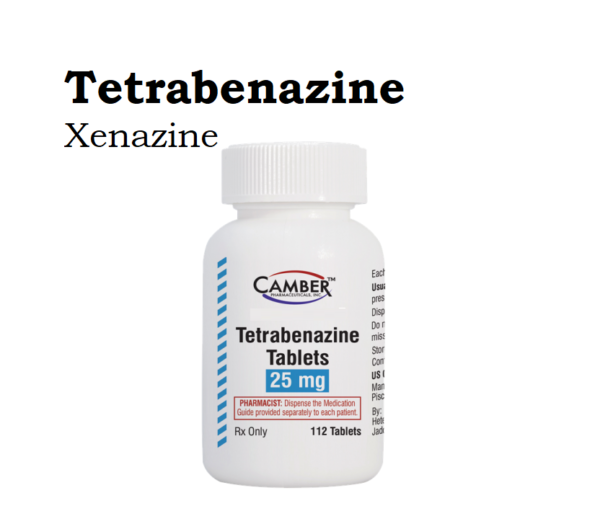
Tetrabenazine (Xenazine) reduces the excitatory neurotransmitters in the brain. It is used in the treatment of hyperkinetic movement disorders.
Indications of Tetrabenazine (Xenazine):
-
Chorea associated with Huntington disease:
- It is prescribed for the treatment of chorea associated with Huntington disease.
- Treatment of chronic tic disorders, including Tourette syndrome
-
Off Label Use of Tetrabenazine in Adults:
- Tardive dyskinesia
Tetrabenazine (Xenazine) dose in Adults
Note: The dose should be individualized and titrated slowly.
Tetrabenazine (Xenazine) dose in the treatment of Chorea associated with Huntington disease:
- Initial: 12.5 mg per oral once daily in the morning,
- The dose may be increased to 12.5 mg b.i.d daily after 1 week.
- The dosage may be increased by 12.5 mg daily at weekly intervals, daily doses >37.5 mg should be divided into 3 doses.
- The maximum single dose is 25 mg.
-
Patients requiring doses >50 mg/day:
-
Genotype for CYP2D6:
-
Extensive and intermediate metabolizers:
- Maximum: 100 mg/day; 37.5 mg/dose
-
Poor metabolizers:
- Maximum: 50 mg/day; 25 mg/dose
-
Concomitant use with strong CYP2D6 inhibitors (eg, fluoxetine, paroxetine, quinidine):
- Maximum: 50 mg/day; 25 mg/dose.
-
-
Note:
- Re-titration is needed if treatment is interrupted for >5 days.
- If treatment is interrupted for <5 days resume at previous maintenance dose.
Tetrabenazine (Xenazine) dose in the treatment of Tardive dyskinesia:
Note: Dose is individualized based on efficacy and tolerance.
- Initial: 50 mg/day per oral in divided doses;
- If needed, the dose may be increased daily by 50 mg every 14 days up to a maximum of 150 mg/day in divided doses.
- Alternatively, an initial dose of 25 to 37.5 mg/day per oral in 2 or 3 divided doses has been recommended with increases or decreases in increments of 12.5 mg/day at weekly intervals.
- The usual maximum tolerated dose:
- 75 mg/day in 3 divided doses;
- in very rare cases, doses up to 200 mg/day have been used.
Tetrabenazine (Xenazine) dose in the treatment of Tourette syndrome:
- Initial: 12.5 mg per oral twice or thrice daily;
- The dose may be increased by 12.5 mg daily at weekly intervals;
- The dose should be increased to maximal tolerated and effective dose.
- The usual maximum tolerated dosage:
- 25 mg 3 times daily.
- The maximum recommended dose:
- 200 mg/day.
Tetrabenazine (Xenazine) dose in Childrens
Tetrabenazine (Xenazine) dose in the treatment of Tourette syndrome:
-
Children and Adolescents:
- Administer 50% of the adult dose.
- Initial: 6.25 mg per oral twice or thrice daily;
- The dose may be increased by 6.25 mg daily at weekly intervals;
- The dose should be titrated slowly to maximal tolerated and effective dose.
-
Dosing adjustment for toxicity:
-
Children and Adolescents:
- Suspension of upward dose titration and dose reduction is necessary for toxicity/adverse reactions, including akathisia, restlessness, parkinsonism, insomnia, depression, suicidality, anxiety, and sedation.
- Therapy should be withdrawn in case of adverse reactions. (tapering not needed).
-
Pregnancy Risk Category: C
- Studies on animal reproduction revealed negative outcomes.
- There is limited information available on the use of tetrabenazine during pregnancy.
Use of Tetrabenazine while breastfeeding
- Breast milk does not contain any Tetrabenazine.
- According to the manufacturer's instructions, the risk/benefits of breastfeeding to an infant and the benefits to the mother will determine whether or not to continue breastfeeding during therapy.
Tetrabenazine (Xenazine) dose in Renal Disease:
There are no dosage adjustments provided in the manufacturer's labeling.
Tetrabenazine (Xenazine) dose in Liver Disease:
Use is contraindicated in case of hepatic impairment.
Side effects of Tetrabenazine (Xenazine):
Note:
Adverse effects are usually dose-related and may resolve at lower dosages. Adverse effects reported for adults with chorea associated with Huntington disease.
Common Side Effects of Tetrabenazine (Xenazine):
-
Central Nervous System:
- Drowsiness
- Sedation
- Depression
- Extrapyramidal Reaction
- Fatigue
- Insomnia
- Akathisia
- Anxiety
- Falling
-
Gastrointestinal:
- Nausea
-
Respiratory:
- Upper Respiratory Tract Infection
Less Common Side Effects of Tetrabenazine (Xenazine):
-
Central Nervous System:
- Drug-Induced Parkinson's Disease
- Equilibrium Disturbance
- Irritability
- Abnormal gait
- Dizziness
- Dysarthria
- Headache
- Obsessive Rumination
-
Gastrointestinal:
- Dysphagia
- Vomiting
- Decreased Appetite
- Diarrhea
-
Genitourinary:
- Dysuria
-
Hematologic & Oncologic:
- Bruise
-
Neuromuscular & Skeletal:
- Bradykinesia
-
Respiratory:
- Bronchitis
- Dyspnea
-
Miscellaneous:
- Laceration
Contraindications to Tetrabenazine (Xenazine):
- Hepatic impairment
- Suicidal ideation and severe untreated depression are common.
- Combination therapy with deutetrabenazine, valbenazine
- Concurrent MAOI therapy or within 2 weeks after MAOI discontinuation
- Combination therapy with or start therapy within less than 20 days of stopping reserpine
- Hypersensitivity to tetrabenazine and any component of the formulation
- If the patient is not under the care and supervision of a psychiatrist familiar with their disorder and the pharmacology of tetrabenazine, he or she should have a history of depression.
Warnings and precautions
-
Akathisia
- Tetrabenazine can cause akathisia.
- Therefore, it is important to monitor for signs and symptoms such as restlessness or agitation and manage them with withdrawal therapy or dosage reduction.
-
Depression in the CNS:
- It can lead to CNS depression, which may result in impaired mental or physical abilities.
- It is important to warn patients about driving or operating machinery.
-
Depression/suicidal thoughts: [US Boxed Warn]
- Huntington disease patients are at high risk of depression and suicidal thoughts. Therefore, it is important to monitor closely throughout treatment.
- Any new or worsening symptoms should be reported to the doctor.
- It should not be given to patients who have had a history of depression, or attempted suicide.
- Tetrabenazine should not be used in patients suffering from severe depression or untreated suicidal thoughts.
- Unresolved depression or suicidal thoughts should prompt the termination of therapy.
-
The risk of aspiration and esophageal dysmotility:
- Tetrabenazine can cause dysmotility, dysphagia and aspiration. Patients at high risk for aspiration pneumonia should not be given it.
-
Neuroleptic malignant Syndrome (NMS).
- A neuroleptic malignant syndrome can present with fever, rigidity of the muscles, or instability.
- It is important to monitor your surroundings carefully.
- With the onset NMS, it is important to stop all therapy.
- The recurrence or recurrence may occur if the therapy is restarted.
-
Ophthalmic effects
- Long-term therapy can cause toxicity and other ophthalmic side effects. In animal studies, it has been shown to bind with melanin-containing tissues.
-
Orthostatic hypotension
- Orthostatic hypotension is a serious condition that can be caused by BP.
-
Parkinsonism
- If you experience any symptoms of parkinsonism such as hypertonia, rigidity or bradykinesia (or other signs), withdrawal may be necessary.
-
Extension of QT
- Different studies have shown that QT interval prolongation can be achieved with either a single drug or in combination.
- Patients with congenital QT prolongation, history or cardiac arrhythmias or concomitant drugs that cause QT extension are at greater risk.
-
Tardive dyskinesia
- Therapy should be stopped if tardive dyskinesia symptoms develop.
-
Prolactin-dependent tumors
- Hyperprolactinemia can be caused by Tetrabenazine
- Patients with breast cancer or other prolactin-related tumors should be cautious about using tetrabenazine. Withdrawal may be necessary in certain cases.
Tetrabenazine: Drug Interaction
|
Ajmaline |
May increase the serum concentration of CYP2D6 Substrates (High risk with Inhibitors). |
|
Alcohol (Ethyl) |
CNS Depressants may enhance the CNS depressant effect of Alcohol (Ethyl). |
|
Alizapride |
May enhance the CNS depressant effect of CNS Depressants. |
|
Antipsychotic Agents |
Tetrabenazine may enhance the adverse/toxic effect of Antipsychotic Agents. |
|
Brexanolone |
CNS Depressants may enhance the CNS depressant effect of Brexanolone. |
|
Brimonidine (Topical) |
May enhance the CNS depressant effect of CNS Depressants. |
|
Cannabidiol |
May enhance the CNS depressant effect of CNS Depressants. |
|
Cannabis |
May enhance the CNS depressant effect of CNS Depressants. |
|
Chlorphenesin Carbamate |
May enhance the adverse/toxic effect of CNS Depressants. |
|
CloBAZam |
May increase the serum concentration of CYP2D6 Substrates (High risk with Inhibitors). |
|
CNS Depressants |
May enhance the adverse/toxic effect of other CNS Depressants. |
|
Cobicistat |
May increase the serum concentration of CYP2D6 Substrates (High risk with Inhibitors). |
|
CYP2D6 Inhibitors (Moderate) |
May decrease the metabolism of CYP2D6 Substrates (High risk with Inhibitors). |
|
Darunavir |
May increase the serum concentration of CYP2D6 Substrates (High risk with Inhibitors). |
|
Dimethindene (Topical) |
May enhance the CNS depressant effect of CNS Depressants. |
|
Doxylamine |
May enhance the CNS depressant effect of CNS Depressants. Management: The manufacturer of Diclegis (doxylamine/pyridoxine), intended for use in pregnancy, specifically states that use with other CNS depressants is not recommended. |
|
Dronabinol |
May enhance the CNS depressant effect of CNS Depressants. |
|
Esketamine |
May enhance the CNS depressant effect of CNS Depressants. |
|
Haloperidol |
QT-prolonging Agents (Indeterminate Risk - Avoid) may enhance the QTcprolonging effect of Haloperidol. |
|
HydrOXYzine |
May enhance the CNS depressant effect of CNS Depressants. |
|
Imatinib |
May increase the serum concentration of CYP2D6 Substrates (High risk with Inhibitors). |
|
Kava Kava |
May enhance the adverse/toxic effect of CNS Depressants. |
|
Lofexidine |
May enhance the CNS depressant effect of CNS Depressants. Management: Drugs listed as exceptions to this monograph are discussed in further detail in separate drug interaction monographs. |
|
Lumefantrine |
May increase the serum concentration of CYP2D6 Substrates (High risk with Inhibitors). |
|
Magnesium Sulfate |
May enhance the CNS depressant effect of CNS Depressants. |
|
MetyroSINE |
May enhance the adverse/toxic effect of Tetrabenazine. |
|
Minocycline |
May enhance the CNS depressant effect of CNS Depressants. |
|
Mirtazapine |
CNS Depressants may enhance the CNS depressant effect of Mirtazapine. |
|
Nabilone |
May enhance the CNS depressant effect of CNS Depressants. |
|
Panobinostat |
May increase the serum concentration of CYP2D6 Substrates (High risk with Inhibitors). |
|
Peginterferon Alfa-2b |
May decrease the serum concentration of CYP2D6 Substrates (High risk with Inhibitors). Peginterferon Alfa-2b may increase the serum concentration of CYP2D6 Substrates (High risk with Inhibitors). |
|
Perhexiline |
CYP2D6 Substrates (High risk with Inhibitors) may increase the serum concentration of Perhexiline. Perhexiline may increase the serum concentration of CYP2D6 Substrates (High risk with Inhibitors). |
|
Pramipexole |
CNS Depressants may enhance the sedative effect of Pramipexole. |
|
QT-prolonging Agents (Highest Risk) |
QT-prolonging Agents (Indeterminate Risk - Avoid) may enhance the QTc-prolonging effect of QT-prolonging Agents (Highest Risk). Management: Monitor for QTc interval prolongation and ventricular arrhythmias when these agents are combined. Patients with additional risk factors for QTc prolongation may be at even higher risk. |
|
QuiNINE |
May increase the serum concentration of CYP2D6 Substrates (High risk with Inhibitors). |
|
ROPINIRole |
CNS Depressants may enhance the sedative effect of ROPINIRole. |
|
Rotigotine |
CNS Depressants may enhance the sedative effect of Rotigotine. |
|
Rufinamide |
May enhance the adverse/toxic effect of CNS Depressants. Specifically, sleepiness and dizziness may be enhanced. |
|
Selective Serotonin Reuptake Inhibitors |
CNS Depressants may enhance the adverse/toxic effect of Selective Serotonin Reuptake Inhibitors. Specifically, the risk of psychomotor impairment may be enhanced. |
|
Tetrahydrocannabinol |
May enhance the CNS depressant effect of CNS Depressants. |
|
Tetrahydrocannabinol and Cannabidiol |
May enhance the CNS depressant effect of CNS Depressants. |
|
Trimeprazine |
May enhance the CNS depressant effect of CNS Depressants. |
|
Risk Factor D (Consider therapy modification) |
|
|
Abiraterone Acetate |
May increase the serum concentration of CYP2D6 Substrates (High risk with Inhibitors). Management: Avoid concurrent use of abiraterone with CYP2D6 substrates that have a narrow therapeutic index whenever possible. When concurrent use is not avoidable, monitor patients closely for signs/symptoms of toxicity. |
|
Asunaprevir |
May increase the serum concentration of CYP2D6 Substrates (High risk with Inhibitors). |
|
Blonanserin |
CNS Depressants may enhance the CNS depressant effect of Blonanserin. |
|
Buprenorphine |
CNS Depressants may enhance the CNS depressant effect of Buprenorphine. Management: Consider reduced doses of other CNS depressants, and avoiding such drugs in patients at high risk of buprenorphine overuse/self-injection. Initiate buprenorphine at lower doses in patients already receiving CNS depressants. |
|
Chlormethiazole |
May enhance the CNS depressant effect of CNS Depressants. Management: Monitor closely for evidence of excessive CNS depression. The chlormethiazole labeling states that an appropriately reduced dose should be used if such a combination must be used. |
|
CYP2D6 Inhibitors (Strong) |
May increase the serum concentration of Tetrabenazine. Specifically, concentrations of the active alpha- and beta-dihydrotetrabenazine metabolites may be increased. Management: Tetrabenazine adult dose should be reduced by 50% when starting a strong CYP2D6 inhibitor. Maximum tetrabenazine adult dose is 50 mg/day when used with a strong CYP2D6 inhibitor. |
|
Dacomitinib |
May increase the serum concentration of CYP2D6 Substrates (High risk with Inhibitors). Management: Avoid concurrent use of dacomitinib with CYP2D6 subtrates that have a narrow therapeutic index. |
|
Droperidol |
May enhance the CNS depressant effect of CNS Depressants. Management: Consider dose reductions of droperidol or of other CNS agents (eg, opioids, barbiturates) with concomitant use. Exceptions to this monograph are discussed in further detail in separate drug interaction monographs. |
|
Flunitrazepam |
CNS Depressants may enhance the CNS depressant effect of Flunitrazepam. |
|
HYDROcodone |
CNS Depressants may enhance the CNS depressant effect of HYDROcodone. Management: Avoid concomitant use of hydrocodone and benzodiazepines or other CNS depressants when possible. These agents should only be combined if alternative treatment options are inadequate. If combined, limit the dosages and duration of each drug. |
|
Methotrimeprazine |
CNS Depressants may enhance the CNS depressant effect of Methotrimeprazine. Methotrimeprazine may enhance the CNS depressant effect of CNS Depressants. Management: Reduce adult dose of CNS depressant agents by 50% with initiation of concomitant methotrimeprazine therapy. Further CNS depressant dosage adjustments should be initiated only after clinically effective methotrimeprazine dose is established. |
|
Opioid Agonists |
CNS Depressants may enhance the CNS depressant effect of Opioid Agonists. Management: Avoid concomitant use of opioid agonists and benzodiazepines or other CNS depressants when possible. These agents should only be combined if alternative treatment options are inadequate. If combined, limit the dosages and duration of each drug. |
|
OxyCODONE |
CNS Depressants may enhance the CNS depressant effect of OxyCODONE. Management: Avoid concomitant use of oxycodone and benzodiazepines or other CNS depressants when possible. These agents should only be combined if alternative treatment options are inadequate. If combined, limit the dosages and duration of each drug. |
|
Perampanel |
May enhance the CNS depressant effect of CNS Depressants. Management: Patients taking perampanel with any other drug that has CNS depressant activities should avoid complex and high-risk activities, particularly those such as driving that require alertness and coordination, until they have experience using the combination. |
|
Sodium Oxybate |
May enhance the CNS depressant effect of CNS Depressants. Management: Consider alternatives to combined use. When combined use is needed, consider minimizing doses of one or more drugs. Use of sodium oxybate with alcohol or sedative hypnotics is contraindicated. |
|
Suvorexant |
CNS Depressants may enhance the CNS depressant effect of Suvorexant. Management: Dose reduction of suvorexant and/or any other CNS depressant may be necessary. Use of suvorexant with alcohol is not recommended, and the use of suvorexant with any other drug to treat insomnia is not recommended. |
|
Tapentadol |
May enhance the CNS depressant effect of CNS Depressants. Management: Avoid concomitant use of tapentadol and benzodiazepines or other CNS depressants when possible. These agents should only be combined if alternative treatment options are inadequate. If combined, limit the dosages and duration of each drug. |
|
Zolpidem |
CNS Depressants may enhance the CNS depressant effect of Zolpidem. Management: Reduce the Intermezzo brand sublingual zolpidem adult dose to 1.75 mg for men who are also receiving other CNS depressants. No such dose change is recommended for women. Avoid use with other CNS depressants at bedtime; avoid use with alcohol. |
|
Risk Factor X (Avoid combination) |
|
|
Azelastine (Nasal) |
CNS Depressants may enhance the CNS depressant effect of Azelastine (Nasal). |
|
Bromopride |
May enhance the adverse/toxic effect of Tetrabenazine. |
|
Bromperidol |
May enhance the CNS depressant effect of CNS Depressants. |
|
Deutetrabenazine |
May enhance the adverse/toxic effect of Tetrabenazine. |
|
Metoclopramide |
May enhance the adverse/toxic effect of Tetrabenazine. |
|
Monoamine Oxidase Inhibitors |
Tetrabenazine may enhance the adverse/toxic effect of Monoamine Oxidase Inhibitors. |
|
Orphenadrine |
CNS Depressants may enhance the CNS depressant effect of Orphenadrine. |
|
Oxomemazine |
May enhance the CNS depressant effect of CNS Depressants. |
|
Paraldehyde |
CNS Depressants may enhance the CNS depressant effect of Paraldehyde. |
|
Piribedil |
May diminish the therapeutic effect of Tetrabenazine. Tetrabenazine may diminish the therapeutic effect of Piribedil. |
|
Reserpine |
May enhance the adverse/toxic effect of Tetrabenazine. |
|
Thalidomide |
CNS Depressants may enhance the CNS depressant effect of Thalidomide. |
|
Valbenazine |
Tetrabenazine may enhance the adverse/toxic effect of Valbenazine. |
Monitoring parameters:
- Orthostatic blood pressure
- Therapy with psychiatric status
- Neuroleptic malignant Syndrome: Signs and Symptoms
- Suicide ideation and signs/symptoms
- CYP2D6 genotyping to evaluate metabolizer status (for patients requiring more than 50 mg/day).
- Movement disorder improvement
How to administer Tetrabenazine (Xenazine)?
It should be given orally without regard to food.
Mechanism of action of Tetrabenazine (Xenazine):
- Tetrabenazine is a reversible inhibitor for the human vesicular monoaminetransporter type 2 (VMAT-2).
- It decreases monoamine uptake into synaptic vessels, which causes depletion of monoamine storage.
- Hydroxytetrabenazine, also known as HTBZ, inhibits VMAT-2 and has a weak binding affinity to dopamine D receptors.
Time: 16-24 hours (at steady state); chorea can recur in 12-18 hours.
ProteinBinding: 82% to 85 %; Metabolites 59% to 68%
Metabolism: The liver produces a large amount of active metabolites rapidly and extensively: Alpha and Beta hydroxy-tetrabenazine via CYP2D6.
Bioavailability: Low and erratic due to large first-pass effects. Food is not likely to affect this condition.
Eliminating half-life:
- Alpha-HTBZ: 7 Hours, 10 Hours (hepatic impairment).
- Beta-HTBZ: 5 hours or 8 hours (hepatic impairment).
- Tetrabenazine: 17.5 Hours (hepatic impairment).
Time until plasma concentration peaks: Metabolites: In 1 to 1.5 Hours
Excretion:
- Urine (75% for metabolites, 10% for alpha and beta HTBZ).
- Feces (7%-16%)
International Brands of Tetrabenazine:
- APO-Tetrabenazine
- Nitoman
- PMS-Tetrabenazine
- Choreazine
- Dystardis
- Feinardon
- Motetis
- Nitoman
- Revocon
- Tetmodis
- Tetrazin
- Trenazin
- Xenazina
- Xenazine
Tetrabenazine Brand Names in Pakistan:
No Brands Available in Pakistan.
.png)


